
Rating Action
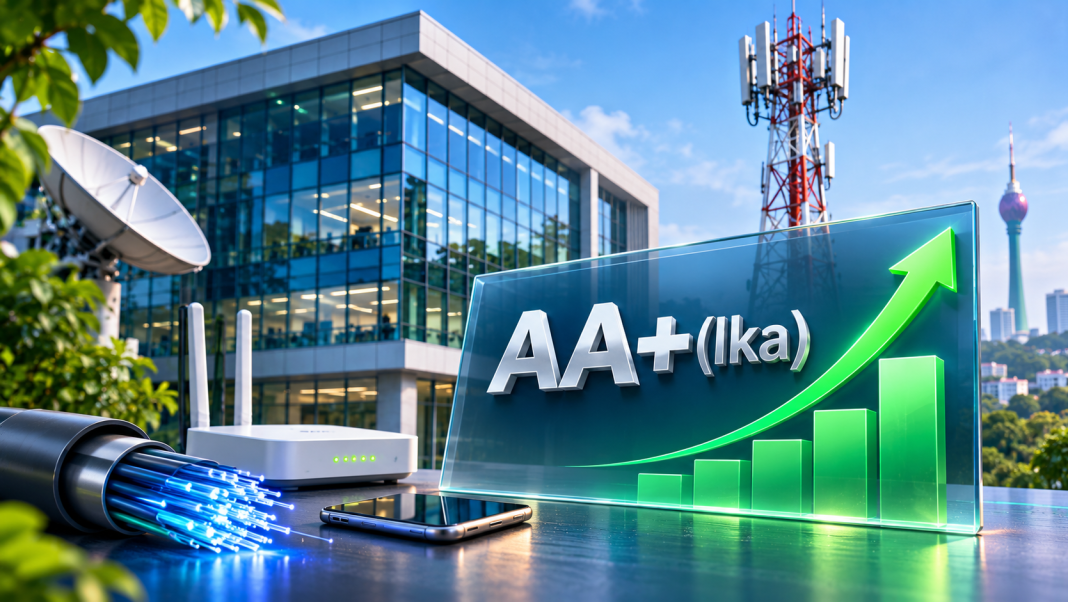
- Fitch Ratings has revised Sri Lanka Telecom PLC’s (SLT) National Long-Term Rating to ‘AA+(lka)’ from ‘AA-(lka)’. The Outlook is Stable.
- The change follows the recalibration of the Sri Lankan National Rating scale, which reflects shifts in relative creditworthiness among Sri Lankan issuers.
- The recalibration came after Fitch upgraded Sri Lanka’s sovereign Long-Term Local-Currency IDR to ‘B-‘/Stable from ‘CCC+’ on 22 September 2026.
- Fitch expects ratings of other rated corporate issuers to remain unchanged because of the recalibration; any other changes will reflect individual performance.
- The Rating Watch Positive was resolved after the state decided not to proceed with SLT’s sale.
- SLT’s ratings remain constrained by its parent’s weaker credit profile under Fitch’s Parent and Subsidiary Linkage and Government-Related Entities criteria.
- SLT’s Standalone Credit Profile is stronger than the state’s, supported by its leadership in fixed telephone and broadband, second-largest mobile share, extensive optical fibre network and stronger financial profile.
Key Rating Drivers
- Disposal plan abandoned: The plan to divest the government’s stake was formally dropped after the Supreme Court’s April 2026 ruling, which Fitch reads as a strategic shift to retain SLT as a key national asset in the digital transformation agenda.
- Investment to support market position: SLT’s investment is expected to support the government’s commitment to guarantee minimum broadband speeds of around 2Mbps nationwide within two to three years. The government aims to grow the digital economy to USD15 billion by 2030. SLT’s financial capacity should support continued investment, including in its recently acquired 3.5GHz 5G spectrum.
- Profitability to strengthen: Fitch forecasts the EBITDA margin to rise to 38% in 2026 (2025: 34%), driven by revenue growth and cost controls. Growth in fibre broadband and mobile subscribers and ARPU improvements should support revenue, with price adjustments helping offset cost pressures from Middle East-related tensions.
- Interest costs to decline: Financing costs are expected to stay broadly unchanged near term, but aggressive debt settlement should lower interest costs over the medium term. Cash interest expense is forecast at LKR 5.2 billion in 2026 (2025: LKR 5.8 billion).
- Improving sector outlook: The telecom sector is expected to see continued topline improvement from evolving data consumption after 5G rollout and the government’s digital agenda.
- Falling leverage, rising margins: 2026 EBITDA net leverage is forecast to improve to around 0.9x for SLT and 0.4x for Dialog Axiata (from around 1.6x and 0.7x in 2025). The sector’s average EBITDA margin is expected to exceed 43% in 2026 (2025: 40%), despite rupee depreciation.
Peer Analysis
- SLT’s rating is comparable with peers rated ‘AAA(lka)’ to ‘AA-(lka)’, including Dialog (AAA(lka)/Stable), Sunshine Holdings (AA+(lka)/Stable) and Singer (Sri Lanka) (AA-(lka)/Stable).
- SLT is rated below Dialog mainly because of the drag from its sovereign parent’s rating.
- Dialog controls over 60% of the mobile market and 50% of fixed broadband, and has a larger revenue base, lower forecast leverage and a better free cash flow profile. SLT’s dominance is mainly in legacy fixed telephone.
- Sunshine is much smaller but rated equally, as its leverage and liquidity ratios are stronger and it has a stronger presence across healthcare, consumer and agriculture.
- SLT is rated two notches above Singer. Revenues are broadly comparable, but SLT has a higher operating margin, while Singer is weighed down by its finance subsidiary and substantially higher net debt.
Key Rating-Case Assumptions
- Revenue growth improves to 9% in 2026 (2025: 2%) and stays at a high-single-digit rate in 2027-2029.
- Operating EBITDA margin expands to 38% in 2026 and holds at that level through 2029.
- Effective tax rate of 30% from 2026 to 2029.
- Capex intensity rises to 16% in 2026 (2025: 15%), then moderates to 15% from 2029 as most 5G and fibre investments are completed.
- Dividend payout of 15% in 2026, rising to 20% of pretax profit in 2027-2029.
Rating Sensitivities
- Downgrade: A downgrade of the sovereign’s Long-Term Local-Currency IDR could lead to a downgrade of SLT’s National Long-Term Ratings.
- Upgrade: An upgrade of the sovereign’s Long-Term Local-Currency IDR could lead to an upgrade of SLT’s ratings.
- The source text also states that a weakening of links between SLT and the sovereign could result in an upgrade, though it is listed under the downgrade factors.
Liquidity and Debt Structure
- Unrestricted cash stood at LKR 19 billion at end-June 2026, including LKR 7 billion of fixed deposits, which covers LKR 10 billion of short-term borrowings maturing within 12 months.
- SLT is likely to depend on refinancing to roll over its long-term debt.
- Access to local banks is expected to remain solid, and the funding mix should gradually normalise as inflation moderates.
Issuer Profile
- SLT is an integrated telecom company with a market-leading position in fixed-voice and broadband, the second-largest position in mobile and a dominant presence in digital TV.
NOTE : For Educational Purposes only, Not a buy or sell recommendation.