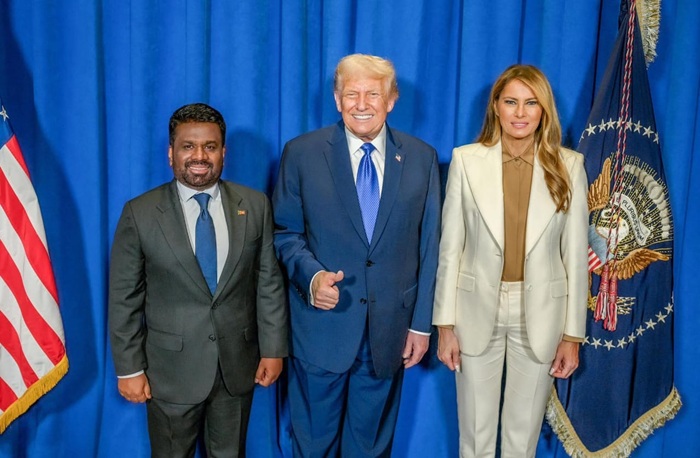

New York / Colombo — In a notable diplomatic development during the 80th Session of the United Nations General Assembly, President Anura Kumara Dissanayake had a cordial discussion with U.S. President Donald Trump at a dinner reception organized for heads of state attending the UN gathering.
What Took Place
According to reports, the meeting was informal and took place at the Lotte New York Palace Hotel during a dinner hosted by President Trump on 23 September 2025. President Dissanayake described the interaction as cordial, indicating that he was able to raise Sri Lanka’s interests in bilateral cooperation.
While media accounts describe the exchange as brief, the Sri Lankan side emphasizes that the opportunity to engage with President Trump reflects a broader effort by Colombo to deepen ties with Washington.
Concurrent Meeting with U.S. Envoy
Earlier the same day, President Dissanayake also met with Sergio Gor, who serves as a Special Envoy for South and Central Asia appointed by former President Trump and Director of the White House Presidential Personnel Office.
The meeting, held at Sri Lanka’s Permanent Mission to the UN, focused on areas of mutual interest: trade, investment, tourism, and efforts to reduce barriers to bilateral commerce. President Dissanayake reaffirmed Sri Lanka’s commitment to structural economic reforms, transparency, and building sustainable growth after its recent crisis.
Also present were Sri Lanka’s Permanent Representative to the UN, Jayantha Jayasuriya, and senior officials from the Ministry of Foreign Affairs.
Significance & Implications
1. Symbolic and Strategic Value
Even if brief, a meeting with President Trump elevates Sri Lanka’s diplomatic profile. It signals Sri Lanka’s readiness to engage with global powers and to recalibrate its foreign policy posture.
2. Economic & Trade Aspirations
Sri Lanka’s pitch during both meetings emphasized renewed interest in stronger trade and investment links with the U.S. The country seeks to rebrand itself as an attractive destination for foreign capital, especially after its economic collapse and debt restructuring efforts.
3. Constraints of Informality
Because the interaction was on the sidelines of the UN assembly, it likely lacked in-depth negotiations or binding commitments. Any real progress will depend on follow-up diplomacy, formal visits, and working-level negotiations.
4. Domestic Reception & Expectations
In Sri Lanka, the news of the meeting has been widely reported and interpreted as a diplomatic win. Some segments see it as validation of President Dissanayake’s foreign policy direction, while skeptics caution against overestimating what such symbolic interactions can deliver.
Challenges Ahead
- Translating goodwill into substance: The real test is converting goodwill from a casual meeting into concrete trade deals, investment flows, or partnerships.
- Reconciling policy with capacity: Sri Lanka’s economic reforms, debt obligations, and structural constraints may limit what it can promise or deliver.
- Balancing global relationships: Sri Lanka must navigate relations with the U.S., China, India, and others without alienating key strategic partners.
- Managing expectations: Overhyping the meeting could lead to disappointment if visible outcomes are limited in the short term.
Outlook
If President Dissanayake’s diplomatic team capitalizes on this window—by arranging follow-up dialogues, articulating clear asks, and preparing to deliver on proposals—the engagement could serve as a stepping stone toward deeper U.S.–Sri Lanka collaboration.
However, much depends on how both sides approach next steps. Washington’s interest in Sri Lanka will hinge on geopolitical calculations, human rights considerations, trade balances, and how Sri Lanka positions itself in regional dynamics.
For now, the meeting stands as a promising signal that Sri Lanka is seeking to broaden its external relations and elevate its voice on the global stage.